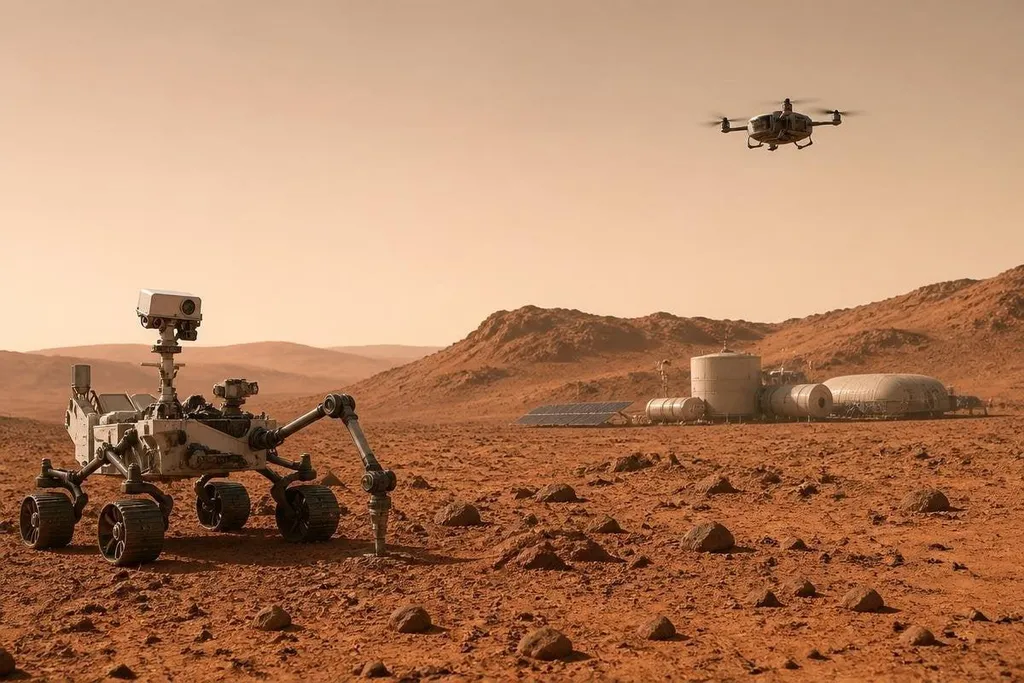
A Mars crew would need air, water, food, shelter, power, and a way home. Robots can prepare much of that work before people leave Earth, while also checking whether a landing site can support human activity.
- Robots can map ground, move equipment, and inspect hazards before a crew arrives.
- Machines may help make oxygen and water from local materials.
- Human crews would still need to repair, guide, and judge the work on site.
What robots can do first
The first useful machines on Mars won't need to look like people. A rover with wheels can carry tools, drill into soil, collect samples, and scan rocks. A small flying robot can inspect slopes or routes that a ground vehicle cannot reach.
That work matters because Mars has no breathable air, low surface pressure, and strong radiation at the ground. A robot can spend months checking a site without consuming food, oxygen, or water meant for a crew.
Robots can also place equipment before the human mission begins. Solar panels, radio gear, weather sensors, and spare parts could be spread across a work area, giving the crew more options when dust or damaged hardware blocks one route.
Making local supplies
A crewed mission carries a large amount of mass from Earth. Robots may cut that burden by using materials already on Mars, a process known as in-situ resource use. The plain version is local production.
One target is oxygen. A machine could process carbon dioxide from the Martian air and store the oxygen for breathing or rocket fuel. Water is another target, but a robot would first need to find ice, check its depth, and remove it from soil without damaging the equipment.
This work has a hard limit: the machine must run for long periods with little help. Solar power can fall when dust blocks the panels, and a stuck drill or failed valve may need a person to fix it.
A design that works in a clean test room still needs to survive cold, dust, vibration, and long radio delays.
A Mars robot may need to spot a hazard and choose a route without live control. That makes its test conditions and failure limits as important as its headline task. Reporting linked through Robot 24 can add those details before the next section looks at radio delay.
Robots and the time delay
Mars and Earth can sit millions of kilometres apart. Radio signals take several minutes to travel one way, so a driver on Earth can't steer around every rock in real time.
That delay makes autonomy necessary. The robot must read its cameras and other sensors, choose a safe route, check its position, and stop when the ground looks unsafe. People on Earth can set goals and review data, but the machine handles the short actions between those instructions.
The same delay changes repair work. A team may send a command, wait for the result, and then wait again for the next image. Robots need clear fault modes, spare parts, simple tools, and software that can keep a problem from becoming a lost vehicle.
I’d send robots ahead of people even if that makes the mission slower, because an empty landing site gives engineers room to find failures without risking a crew.
What remains unproven
Robot-first planning has limits. Machines still struggle with loose soil, steep ground, blocked views, worn joints, and tasks that need touch rather than cameras. A human can change tools, clear a jam, or decide that a sample is worth collecting. A robot needs those choices written into its software or sent across the delay.
The largest gap is repair. A Mars machine that cannot fix its own wheels, power system, drill, or communications gear may stop before the crew arrives. That makes spare hardware and simple mechanical designs as important as better driving software.
A mission plan should answer these questions before it books a launch:
- Power: Can the robot work through dust, winter, and long nights?
- Repair: Can a crew replace the parts most likely to fail?
- Supplies: Can the machine find and process local water or carbon dioxide?
- Distance: Will the robot make safe decisions during the radio delay?
- Proof: What result shows that the site and equipment are ready for people?
The next useful step is a robot that performs a complete work cycle: find a resource, collect it, process it, store the result, and report each stage. Until a machine can do that on Mars with little help from Earth, human travel remains a transport problem with a large amount of unfinished work waiting at the destination.